Physical Address
304 North Cardinal St.
Dorchester Center, MA 02124
Physical Address
304 North Cardinal St.
Dorchester Center, MA 02124

You have saved the capital. You understand the importance of compound interest. But when you look at the menu of investment options, the clarity disappears. The financial industry often complicates the narrative, making you feel like you need a degree in economics just to park your cash effectively.
At Build Your Own Nest Egg, we believe your financial future belongs to you, not a salesperson. Building a robust portfolio isn’t about picking the “winning” lottery ticket; it’s about structural engineering. You need the right materials for the right purpose.
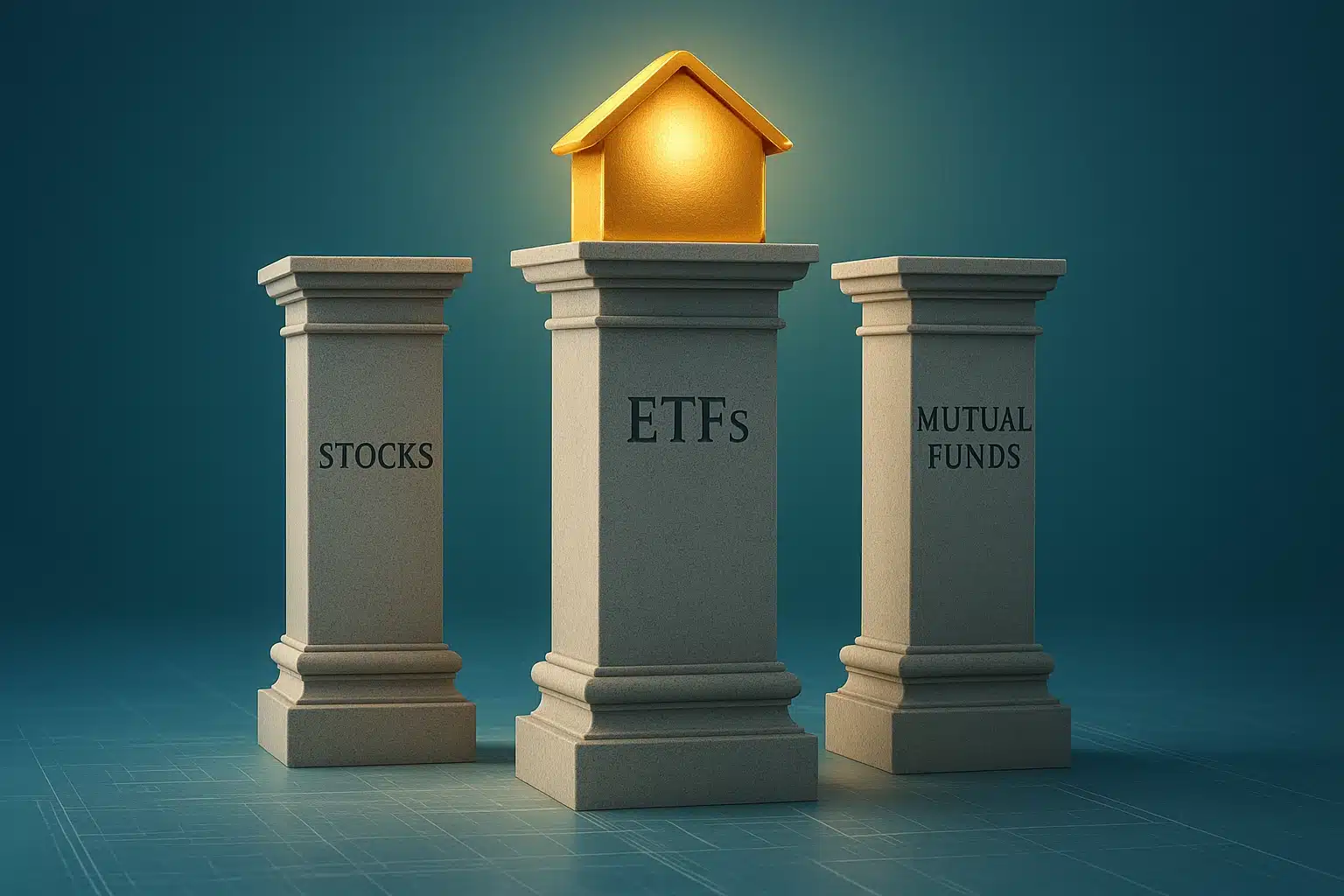
This guide moves beyond dictionary definitions. We are going to evaluate the four pillars of modern investing—Stocks, Bonds, ETFs, and Mutual Funds—analyzing their mechanics, their risks, and exactly how they fit into the blueprint of your financial independence.
When you buy a stock, you aren’t just buying a ticker symbol; you are buying equity—actual ownership—in a business. Stocks are the growth engine of almost every significant retirement portfolio.
Historically, equities have provided the highest potential returns over the long term. For context, U.S. stocks saw gains of approximately 17% in 2025, driven largely by the communication services and technology sectors. However, that growth comes with the “price” of admission: volatility.
In finance, we use a concept called the [Risk Premium Explained]. This is essentially the extra return you demand for taking on the risk of the stock market compared to a “risk-free” asset like a government treasury bill. If a company underperforms, the stock price drops. If it goes bankrupt, you could lose the entire investment.
This is why individual stock picking requires significant due diligence. You are betting on the execution of a single management team. For most builders of wealth, stocks are essential, but how you access them (individually vs. pooled) matters immensely.
If stocks are the engine, bonds are the suspension system. When you invest in a bond, you are not an owner; you are a lender. You loan money to a corporation or government for a set period, and in return, they pay you interest (the coupon) and return your principal at maturity.
Many investors assume bonds are risk-free. While they are generally safer than stocks, they have their own vulnerabilities. It is crucial to understand the reality of a [Bond Bear Market Reality]. Unlike a stock market crash where prices plummet due to earnings fears, a bond bear market is usually driven by rising interest rates and inflation adjustments.
When new bonds are issued with higher interest rates, existing bonds with lower rates become less valuable. However, the price drop is rarely as violent as an equity crash. Bonds serve a specific role in your nest egg: capital preservation and income generation. They act as the ballast that keeps your portfolio steady when the stock market gets choppy.
Most independent investors shouldn’t be trying to pick the next tech unicorn or analyze corporate balance sheets. This is where pooled investment vehicles—Mutual Funds and Exchange-Traded Funds (ETFs)—become your most powerful tools.
These vehicles allow you to buy a basket of hundreds or thousands of stocks or bonds in a single transaction. This instant diversification is the single most effective way to mitigate the risk of any one company failing.
Mutual funds are the traditional heavyweights of the investment world, with U.S. assets reaching $29.11 trillion as of January 2025.
For a deeper look into how these pools operate behind the scenes, it’s worth reviewing [Mutual Fund Mechanics].
Exchange-Traded Funds (ETFs) have surged in popularity because they democratize access to specific markets.
![IMAGE 2]
| Feature | Mutual Funds | ETFs (Exchange-Traded Funds) |
|---|---|---|
| Management Style | Mostly Active (Human decisions) | Mostly Passive (Tracks Index) |
| Trading | Once per day (Market close) | Real-time (Market hours) |
| Fees (Expense Ratio) | Typically Higher (0.5% – 1.5%+) | Typically Lower (0.03% – 0.5%) |
| Tax Efficiency | Lower (Capital gains passed to you) | Higher (Structure minimizes taxable events) |
| Minimum Investment | Often $1,000 – $3,000 | Price of 1 share (or fractional shares) |
Building your nest egg is no longer just about a 60/40 split between stocks and bonds. The landscape is shifting. Institutional investment in alternative assets is projected to reach $30 trillion by 2035, and we are seeing “hybrid” funds that blend public and private markets becoming more accessible to everyday investors.
Furthermore, [Stock Market Trends] indicate that sectors like Artificial Intelligence and sustainable energy are reshaping what “growth” looks like. ETFs now exist that allow you to target these specific niches without having to bet on a single company like NVIDIA or Tesla.
Q: Do I need a broker to buy these?A: Yes, but “broker” today means a low-cost online platform. You do not need a human stockbroker calling you with tips. You can purchase Stocks, ETFs, and Mutual Funds through any major brokerage app.
Q: Can I lose all my money in an ETF?A: It is highly unlikely, though mathematically possible. An ETF holding the S&P 500 would only go to zero if the 500 largest companies in America all went bankrupt simultaneously. If that happens, money is likely the least of our problems.
Q: Are Mutual Funds becoming obsolete?A: Not necessarily. While ETFs are growing faster, mutual funds are still dominant in employer-sponsored retirement plans (like 401ks) where ETFs are often not an option.
Understanding these vehicles is the first step in moving from a saver to an investor. You don’t need to use all of them, but you do need to use the ones that align with your timeline.
The most dangerous action is inaction. Use the information above to assess your current holdings. Are you paying high fees for a mutual fund that underperforms a basic ETF? Is your portfolio exposed entirely to stocks without the ballast of bonds?
For a clearer picture of how these variables affect your specific timeline to financial independence, we recommend running your numbers through our [Retirement Nest Egg Calculator]. It will help you visualize how a mix of these asset classes translates into a secure future.